
Introduction To Recruiting
 Section 1: How & When to start the process
“You can send a bunch of emails and attend a bunch of camps and showcase … At the end of the day you’ve got to be good – keep working on your skills.”
Parents/Player
This is always the biggest question, the answer lies with the individual! We suggest the 2nd year of 14u and no later than the 2nd year of 16u.
Parents, please realize that this is a alot of added stress and pressure on the player. So as a parent be encouraging and offer information. But do not dictate direction to them.
Let them figure it out and learn as they go. This is a great teaching/learning experience for them – allow them to explore options!
Step one:
Ask three (3) questions to start the process when the player is ready:
- How far away from home do you want to be?
- 50% of college students stay within 100 miles of home
- The earlier they start the process the further they want to be away, but this changes very quickly as they get older
- Do you want a large or small campus?
- How did you like your high school?
- Was it large or small?
- Where do you see yourself?
- Do you like big crowds?
- Is your friend group large?
- Do you know what you want to study?
- Do you have an idea?
- It is ok if you do not know!
- Approx 80% of students change their majors through out their college education
- It is OK to go in undecided – in fact most college coaches approve that
All of these questions do not need to be answered right away – but just answering one or two will allow you to narrow your search!
Step two:
Once you have an answer or two you can start looking into different colleges.
- You can use Wikipedia.com and research colleges within your area.
- Make a list of 10 colleges you are interested in
- This list is not set and does not define you
- This list WILL continually change as the player learns about what they want and do not want
- This is a starting point only to get them understanding the process
- Of all the players we have worked with to get to the next level only 1 player did so at a college on their original list
- Make a list of 10 colleges you are interested in
- You can then find the softball info you need off of the college website
- Head coaches emails
- Assistant coaches emails
- Look at the roster and review different majors within the roster and see if they align with your goals
- Many colleges frown on athletes with certain majors such as nursing or bio-chem
- Look for camps softball camps offered
-
- Most all colleges have a camp on the fall and one in the spring
- At camps you get a hands on experience
- With the campus
- With the coaches
- With the players
-
Step three:
You are now ready to start emailing, going to camps, or campus visits
- Use the email tutorial to start the email process
- Parents let the player send the emails in their own words
- Allow the player to start asking questions without judgement
- It is a long process but in the end the knowledge self-awareness they gain is worth it.
- Let the player research schools and edit their list based on who THEY are and want – not what we want as parents
It is never too early to start the process and never too early to start getting experience and knowledge, the key is you have to start!!!!
"HOW & WHEN TO START"
Section 2: Email Breakdown
Emails are by far the best form of communication and advocation that can be done by the player and travel ball coach.
We will cover some different types of emails and what to put in them and the best way to format them based on what we found college coaches like. (There will also be samples available.)
Subject line and signature line of every email sent should be consistent:
- Subject line – Name, number, grad year, position, travel team
- Jane Doe, #24, 2023, P/U, Ohio Storm 04
- Signature Line
- Jane Doe #24
- Pitcher/Utility
- Bat Left/Field Right
- 2023 Graduate
- ALWAYS attach a profile
- By screenshot or pic
- Link to your profile
- QR Scan
INTRODUCTION EMAIL (sent once):
This is the first email sent to college coaches telling them a little about yourself – this is the first step to getting on their radar.
A big question is WHEN should we start this. We suggest second year 14u and no later than second year 16u. There is a learning curve to it and can be a bit overwhelming, but like anything else, the more you do it the easier and quicker it is. Plus the earlier it is done the more the college coach is aware.
- You want to address and email the head coach and copy all assistant coaches (many colleges have the assistants coordinating the recruiting process)
- Subject line (see above)
- Body of the email should included:
- A few lines about yourself (include GPA is high)
- A line about their athletic and academic program that you like
- Use bullet point format – try staying away from long paragraphs
- Remember this is an introduction email – they will be hearing a lot from you in the future emails
- Keep Signature Line the same
- Attach your profile
In-Season Emails (sent weekly):
This email is sent after each event filling the coach in on the past week, next weeks schedule, and any other weekly highlight you want them to know.
- These emails are how they get to know you and your personality much better
- Again you want to email the head coach and all assistants
- Use the same subject line as always
- Want to let them know how the last weekend went with a brief one line sentence
- Can also tell them your highlight of the week off the field in a sentence (this is how they start to get to know your personality)
- Finally let them know the event, location and schedule for next week (make sure you include who you are playing against)
- Battle of Teams Event
- Location: Berliner Sports Park – 2203 Greenlawn Ave. Columbus
- 12:30pm Field 8 vs Buckeye Elite
- 3:30pm Field 18 vs Indy Elite
- 5:30pm Field 18 vs Tenn Battlecreek
- Keeps signature line the same
- Attach your profile
Camp Emails (sent before and after attending camps):
These are sent two days before the camp and the day after the camp.
- On these on the subject line just put Your name -camp attendee
- Jane Doe – Feb 23rd Camp Attendee
- In a single sentence thank them for something specific that came out of the camp in which they discussed or helped you with
- The next sentence you can ask questions based on the camp
- Let them know you will be in touch about your future schedule
- If it is a multiple coach camp send a separate email to each coach
- Keep signature line the same
- Attach your profile
On the site you will also be able to view samples of actual emails sent from players, please take note:
- They are not perfect
- There is misspelling and bad grammar
- It is a learning curve
- Parents – DO NOT WRITE THE EMAIL FOR THE PLAYER
- College coaches can tell
- It allows their personality to show and separates them from others
"EMAIL BREAKDOWN"
"EMAIL SAMPLES"
Section 3: Profile Sheet
How important is a profile?
- Very important
- Let’s college coaches know a great deal about you
- Helps form your personality
- It is very easy to attach to an email
- Via link
- Via screenshot
- Print them on heavy paper – to allow college coaches to write on
What to have on the profile:
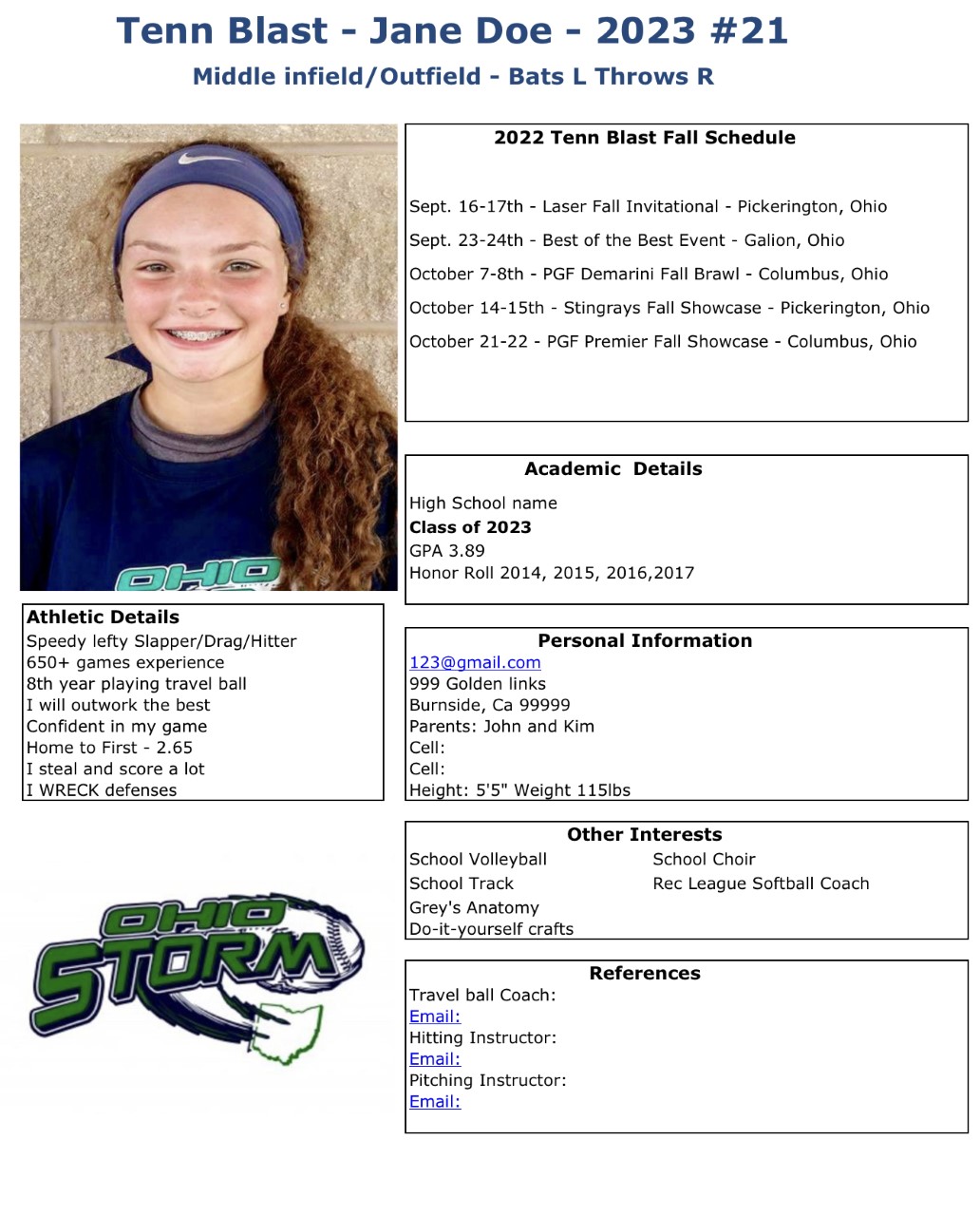
- Softball style photo
- Schedule
- Academic Details
- Athletic Details
- DO NOT PUT CAMP OR CLINIC INFO ON THE PROFILE
- Personal Info
- Other Interests
- References
- Travel Ball Coach
- Instructors
- Travel Ball Team logo
On this site you can download a black profile copy and fill it in with your info. And now you have a profile!
Tenn Blast – lane Doe – 2023 #21 Middle infield/Outfield – Bats L Throws R
"PROFILE SHEET"
"PROFILE TEMPLATE"
Section 4: Travel Ball Coaches
What can you do to help the team:
Identify what level team you have
- Play in events against like competition
- Play in events that have a good college coach showing
- These are in every state
- College coaches usually know their recruiting schedule and where they are going to be by the end of May
- Call and find out where your targeting college coaches will be and get there
- Showcase the players accordingly – do not have favoritism
- During pool play do a showcase batting order
- Whoever is the last out of the game the next person in the lineup now becomes lead off for the next game
- If a college coach is there to watch a player or because a player emailed them – PLAY HER
- Still floors me but it can not tell you how many times a college coach has complained about this
What can you do to help the players:
- If your players are serious about going to the next level they have to understand
- It’s a huge commitment
- It’s a tremendous amount of dedication
- They HAVE to separate themselves from other player
- College softball is not easy and less than 3% get the opportunity
- Set requirements for each player, this will ensure a consistent message see below for some examples we have seen used in the past:
- 10 emails must be sent a week, you get blind-copied
- Maintain a certain GPA
- Must attend X number of college camps a year
- Must have a hitting/pitching instructor
- We even made it a requirement that they have to take the ACT/SAT as freshman
- Must maintain a positive attitude and effort towards the game and others
- If you set requirements make sure there are consequences if they do not do them – but be consistent with all players
- Once you have a team of like minded players you will be amazed at the results.
What can I do to help advocate for my players:
A college coach does not care about your whole team, they come to watch those players that show interest in their program.
A college coach will NEVER ask a player or TB coach
- What was your team record?
- What’s the score?
If you are at an event with college coaches:
- Get off of third or first base
- Introduce yourself and team to the coach or assistant
- Answer their questions
- Walk away
- Keep a list and send a follow up email to them
When players goto camps:
- Send pre camp and post camp emails on behalf of the players attending
- Call the coach after the camp
- Express the interest your player has in their program
Every Sunday after events:
- Spend an hour emailing the coaches your players are interested in
- Follow up on any college questions your players have
- Follow up with your players to make sure they are following your requirements
Social Media:
- Work on getting at least 1000 followers on your social media
- Tag college coaches
- POST – POST – POST
This is not easy and it takes time, but as a coach you can not expect the players to be the only ones committed to the process.
"TRAVEL BALL COACHES"
Section 5: College Division Breakdown
There are three divisions in the NCAA and the NAIA is all under one division (which compared to NCAA matches more closely to D2s)
The main difference between NCAA and NAIA is their respective governing bodies. The governing body of the NCAA is a board of members and the governing body of NAIA is a council of presidents.
Below is a breakdown of different information on each of the four (4) divisions. The averages are based on 10 random colleges in each level in a four state area.
NCAA DIVISION 1:
- Contact Period
- September 1st of Junior year with player or parent/guardian
- Camps and clinics discussion at time as needed
- If fully funded – 12 full scholarships
- Avg tuition per year – 14,732
- Avg student body – 25,873
- Avg number of majors – 153
- Avg softball roster – 23.5
- Allowed to play 56 number of games per year
- Typical weekly schedule of a D1 softball player
- Monday
- 6:15-7:30am Lift/Conditioning
- 3:15-4:30pm Team Practice
- 4:30-5:30pm Small Group Practice
- Tuesday
- 3-5:30pm Team Practice
- Wednesday
- 6:45-8am – Lift/Conditioning
- 3:15-4:30pm Team Practice
- 4:30-5:30pm Small Group
- Thursday
- 3:30-6pm – Team Practice
- Friday
- 7-8:15am – Lift/Conditioning
- Saturday
- Practice time varies
- Monday
NCAA Division 2:
- Contact Period
- June 15th of Junior Year with player or parent/guardian
- Camps and clinic discussion as needed
- If fully funded – 7.2 full scholarships a year
- Avg tuition – 23,017
- Avg student body – 4,813
- Avg number of majors – 57
- Avg softball roster – 23
- Allowed to play 56 number of games a year
- Typical weekly schedule of a D2 softball player
- Monday
- 3-5pm Team Practice
- Tuesday
- 6:50-8am Lift/Conditioning
- 12-1:30pm Team Practice
- Wednesday
- Off Day
- Thursday
- 6:50-8am – Lift/Conditioning
- 8-10am – Team Practice
- Friday
- 6:45-9am – Team Practice
- 2:30-3pm – Conditioning
- Saturday
- Practice time varies
- Monday
NCAA Division 3:
- No limitations on player contact
- Does not offer any athletic scholarships
- Avg tuition – 36,404
- Avg student body – 1697
- Avg number of majors – 45
- Avg softball roster – 23.5
- Allowed to play 56 games a year
- Typical weekly schedule of a D3 softball player
- Monday
- 6-8am Team Lift
- 4-6pm Team Practice
- Tuesday
- 6-8am Team Lift
- 4-6pm Team Practice
- 7-8pm Study Tables
- Wednesday
- 6-8am Team Lift
- 4-6pm Team Practice
- Thursday
- 6-8am team Lift
- 4-6pm Team Practice
- 7-8pm Study Tables
- Friday
- 6-8am Team Lift
- 4-6pm Team Practice
- Saturday
- Practices vary
- Monday
NAIA:
- No limitations on player contact
- Allowed up to 10 full scholarships a year
- Avg tuition – 25,125
- Avg student body – 3,353
- Avg number of majors – 47
- Avg softball roster – 22.8
- Allowed to play up to 28 dates or 56 games a year
- Typical weekly schedule of a NAIA softball player:
- Monday
- 8-10am Lift/Conditioning
- 4-6pm team Practice
- Tuesday
- 4-6pm Team Practice
- Wednesday
- 8-10am Lift Conditioning
- 4-6pm Team Practice
- Thursday
- 4-6pm team Practice
- Friday
- 8-10am Lift Conditioning
- 4-6pm Team Practice
- Saturday
- Practice time varies
- Monday
Since not all programs are fully funded (meaning they have the full number of scholarships available) it is a great question to ask.
*Schedules are actual times from current players